

Master Media Innovation
1-year professional master’s programme | English-taught

On campus in Breda
Full-time on our campus in the south of the Netherlands.

Rooted in R&D
Learn from researchers driving real media innovation.

Work for real clients
Solve live cases from real clients such as KLM, Samsung and Banijay.

Work on immersive media projects
In collaboration with R&D unite (CRADLE).

Accredited MA degree
A recognised one-year master’s, taught fully in English.

Innovate with new tech
Turn emerging media tech into future-ready concepts.

Study overview
The Master Media Innovation teaches you to look beyond the surface of digital media. You will learn to analyse media-related issues in depth and translate your findings into innovative, market-ready concepts. The multidisciplinary approach involves working across media theory, business, emerging technologies, design, communications and R&D, with lecturers from both academic and commercial backgrounds. No technical or programming background is required, making the programme suitable for graduates and beginners from a wide range of fields.
It is also a highly international programme. You will study alongside students, lecturers, re-searchers and industry partners from around the world. This global learning environment gives you valuable international perspectives and the skills you need to work in an increasingly global media industry.
The programme lasts 12 months and consists of four blocks. Throughout the year, you will complete three modules in preparation for your graduation project (15 ECTS credits). More information on these components can be found below.
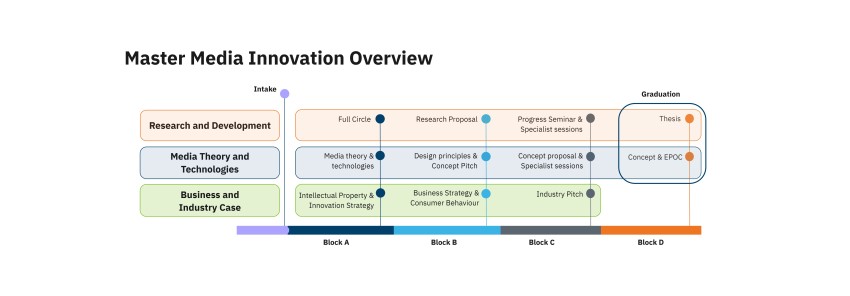
- Research and Development
This module will improve your applied R&D skills on a master's level. You will deepen your skills in academic research in relation to industry, learning how to apply insights from research and theories on new (immersive) media innovations. After completing the module, you will be able to translate insights into well-defined problems and (research) questions, and convert findings into practical recommendations for media design and development while maintaining a critical perspective on research conducted within the media field.
Guided by lecturers with experience in both academic and industry R&D projects, you will apply the knowledge around three goals:
- to create and test innovative persuasive messages (ads)
- to develop the skills to effectively pitch ideas in both industry and academic contexts
- to prepare you for your graduation as well as support you in R&D around the other modules
In addition, you will have the opportunity to learn about, practise with, and make use of the facilities in our R&D labs, including the Experience Lab, VR Lab, and XR Stage, while participating in international R&D projects with real-world clients. This module also supports and offers opportunities to translate your work into academic or industry publications and keynote presentations.
Lecturers
- Prof. Dr Marnix van Gisbergen, Professor of Digital Media Concepts (XR Strategies)
- Dr Shima Rezaei Rashnoodi, Coordinator and Senior Researcher (XR Architecture & Participatory Design)
- Dr Fabio Campos, Senior Researcher & Lecturer (XR Adoption & Predictive Modelling and Design)
- Dr Miruna Doicaru, Researcher & Lecturer (XR Film & Journalism Flow & Experience)
Examples of R&D clients & knowledge institutes
Banijay Benelux, DPG Media, Google, NPO, 4DR Studios, Queensland University of Technology, University of Oregon, Mindlabs, Griffith University, Universidade Federal de Pernambuco, Manchester Metropolitan University.- Media Theory and Technologies
The Media Theory and Technologies learning path firstly introduces students to (contemporary) Media Theory, an interdisciplinary field of study that focuses on the content, history and effects of different media. The interdisciplinary approach is reflected in the various theoretical perspectives and topics covered – including but not limited to – transmedia, ethics, game design and narratology.
Following this, students will be introduced to the topic of emerging (media) technologies, innovation, and design techniques, which culminates in students pitching an innovative media concept. The concept pitch is subsequently built upon as students are introduced to a range of methods for understanding and identifying user requirements; assessing technical feasibility, principles for creating a prototype user interface and interaction, as well as user testing, which leads to a written concept proposal that is an iteration of the initial concept pitch. This project concept will then be developed further as part of the Media Concept section of the graduation process.
The learning path assumes that students have no technical or programming knowledge and is therefore suitable for students from all fields of study. In addition, during the learning path, deep-dive sessions for specific technologies and concepts are offered, dependent upon student needs.Lecturers:
- Oliver Davies, Senior Lecturer (Media Theories and Storytelling)
- Deniz Kurt, Lecturer (Creative Technologies)
- Dr Elcin Hanci, Lecturer (Applied Behavioural Sciences)
- Dr Fabio Campos, Senior Researcher & Lecturer (XR Adoption & Predictive Modelling and Design)
- Mathias Quathem, Lecturer (Ethics)
- Business and Industry case
The Business and Industry Case learning path revolves around the knowledge, tools, and practical insights needed when dealing with topics such as intellectual property, strategy, innovation, entrepreneurship, and consumer behaviour. Besides general concepts and topics, the focus is on specific characteristics of the media and entertainment industry.
As a significant part of the course material has strategic content, the Master Media Innovation also uses a case study from the media industry. Each year, a different client from the field is selected, and students work on a practical case. This gives students the chance to use and apply the theory they have learned in the programme to solve real, existing problems.
Een belangrijk onderdeel van de opleiding is het werken aan een praktijkgericht innovatie-vraagstuk in samenwerking met een partner uit het werkveld. Hoewel de specifieke casus elk jaar verandert, blijft de focus hetzelfde: het toepassen van onderzoek, theorie en ontwerpmethoden om complexe media-vraagstukken aan te pakken en innovatieve conceptuele oplossingen te ontwikkelen. Partners uit het bedrijfsleven zijn actief betrokken gedurende het hele proces; zij helpen bij het omschrijven van het vraagstuk, geven feedback en beoordelen de eindresultaten. Eerdere partners waren onder meer Banijay, DPG Media, IBM, KLM en Samsung.
Lecturers:
- Dr Michelle Kovacs Grigg, Senior Lecturer (Consumer Behaviour)
- Prof. Dr Marnix van Gisbergen, Professor of Digital Media Concepts (XR Strategies)
- Linda Waller, Lecturer (Business Strategies)
- Dr Milena van Voorden, Lecturer (Law and Intellectual Property)
- Oliver Davies, Senior Lecturer (Media Theories and Storytelling)
- Graduation project
Your final project consists of two parts. You will write a master’s thesis on a topic of your choice, and you will develop an innovative media concept with a working prototype or proof of concept. Together, they show what you have learned: R&D, innovation and hands-on media design.
The programme lasts 12 months and is structured into four blocks of nine to ten weeks, comprising a combination of primarily individual assignments, selected group projects, a practice-oriented industry assignment, and a graduation project.
For the full-time variant, there are two to three class days per week on the Breda campus; for the Executive it concerns two to three evenings per week online.
This master’s has a study load of approximately 40 hours per week.
The Master Media Innovation is a one-year, full-time programme. The total study load is 60 ECTS credits. With 1 ECTS credit being equivalent to 28 hours of study, this means that the programme has a study load of approximately 40 hours per week.
- A typical week
Below, you will find an example of a typical week. Keep in mind that your timetable may vary each week, and this example serves as an indication.
Monday
- 11.00-12.00: Media Theory lecture
- 12.00-13.00: Lunch
- 13.00-17.00: Media Technology lecture
Wednesday
- 11.00-12.00: Research & Communication lecture
- 12.00-13.00: Lunch
- 13.00-17.00: Research & Communication lecture
Friday
- 11.00-12.00: Media Theory lecture
- 12.00-13.00: Lunch
- 13.00-17.00: Media Business lecture
Sometimes you have a feedback session on Tuesday or Thursday.
We offer you a small-scale study environment, as the number of students involved in this master is limited. The programme coordinator is always available to help you with day-to-day issues. Additionally, if you wish to discuss personal problems that may be affecting your life as a student, you can turn to the student counsellor.
Student well-being
BUas encourages and helps you to make the most of yourself, whatever your circumstances. Maybe you have a chronic illness, are a family carer, a competitive athlete, or juggle your studies with running your own business? Our study coaches, student counsellors and student psychologists are here to help. Do you need extra support or advice? Or extra facilities? Then take a look at the options here.
At BUas, you develop your entrepreneurial skills in all programmes. You can also join BUas Startup Support (BUSS), where you attend networking meetings and receive guidance from a startup coach.
Would you like to graduate with your own company? You can do that at any academy, although a selection procedure may apply. Whether you are already generating revenue or just have an initial idea, BUas Startup Support will help you.
Read more about starting your own business.
- Course content
-
The Master Media Innovation teaches you to look beyond the surface of digital media. You will learn to analyse media-related issues in depth and translate your findings into innovative, market-ready concepts. The multidisciplinary approach involves working across media theory, business, emerging technologies, design, communications and R&D, with lecturers from both academic and commercial backgrounds. No technical or programming background is required, making the programme suitable for graduates and beginners from a wide range of fields.
It is also a highly international programme. You will study alongside students, lecturers, re-searchers and industry partners from around the world. This global learning environment gives you valuable international perspectives and the skills you need to work in an increasingly global media industry.
The programme lasts 12 months and consists of four blocks. Throughout the year, you will complete three modules in preparation for your graduation project (15 ECTS credits). More information on these components can be found below.
- Research and Development
This module will improve your applied R&D skills on a master's level. You will deepen your skills in academic research in relation to industry, learning how to apply insights from research and theories on new (immersive) media innovations. After completing the module, you will be able to translate insights into well-defined problems and (research) questions, and convert findings into practical recommendations for media design and development while maintaining a critical perspective on research conducted within the media field.
Guided by lecturers with experience in both academic and industry R&D projects, you will apply the knowledge around three goals:
- to create and test innovative persuasive messages (ads)
- to develop the skills to effectively pitch ideas in both industry and academic contexts
- to prepare you for your graduation as well as support you in R&D around the other modules
In addition, you will have the opportunity to learn about, practise with, and make use of the facilities in our R&D labs, including the Experience Lab, VR Lab, and XR Stage, while participating in international R&D projects with real-world clients. This module also supports and offers opportunities to translate your work into academic or industry publications and keynote presentations.
Lecturers
- Prof. Dr Marnix van Gisbergen, Professor of Digital Media Concepts (XR Strategies)
- Dr Shima Rezaei Rashnoodi, Coordinator and Senior Researcher (XR Architecture & Participatory Design)
- Dr Fabio Campos, Senior Researcher & Lecturer (XR Adoption & Predictive Modelling and Design)
- Dr Miruna Doicaru, Researcher & Lecturer (XR Film & Journalism Flow & Experience)
Examples of R&D clients & knowledge institutes
Banijay Benelux, DPG Media, Google, NPO, 4DR Studios, Queensland University of Technology, University of Oregon, Mindlabs, Griffith University, Universidade Federal de Pernambuco, Manchester Metropolitan University.- Media Theory and Technologies
The Media Theory and Technologies learning path firstly introduces students to (contemporary) Media Theory, an interdisciplinary field of study that focuses on the content, history and effects of different media. The interdisciplinary approach is reflected in the various theoretical perspectives and topics covered – including but not limited to – transmedia, ethics, game design and narratology.
Following this, students will be introduced to the topic of emerging (media) technologies, innovation, and design techniques, which culminates in students pitching an innovative media concept. The concept pitch is subsequently built upon as students are introduced to a range of methods for understanding and identifying user requirements; assessing technical feasibility, principles for creating a prototype user interface and interaction, as well as user testing, which leads to a written concept proposal that is an iteration of the initial concept pitch. This project concept will then be developed further as part of the Media Concept section of the graduation process.
The learning path assumes that students have no technical or programming knowledge and is therefore suitable for students from all fields of study. In addition, during the learning path, deep-dive sessions for specific technologies and concepts are offered, dependent upon student needs.Lecturers:
- Oliver Davies, Senior Lecturer (Media Theories and Storytelling)
- Deniz Kurt, Lecturer (Creative Technologies)
- Dr Elcin Hanci, Lecturer (Applied Behavioural Sciences)
- Dr Fabio Campos, Senior Researcher & Lecturer (XR Adoption & Predictive Modelling and Design)
- Mathias Quathem, Lecturer (Ethics)
- Business and Industry case
The Business and Industry Case learning path revolves around the knowledge, tools, and practical insights needed when dealing with topics such as intellectual property, strategy, innovation, entrepreneurship, and consumer behaviour. Besides general concepts and topics, the focus is on specific characteristics of the media and entertainment industry.
As a significant part of the course material has strategic content, the Master Media Innovation also uses a case study from the media industry. Each year, a different client from the field is selected, and students work on a practical case. This gives students the chance to use and apply the theory they have learned in the programme to solve real, existing problems.
Een belangrijk onderdeel van de opleiding is het werken aan een praktijkgericht innovatie-vraagstuk in samenwerking met een partner uit het werkveld. Hoewel de specifieke casus elk jaar verandert, blijft de focus hetzelfde: het toepassen van onderzoek, theorie en ontwerpmethoden om complexe media-vraagstukken aan te pakken en innovatieve conceptuele oplossingen te ontwikkelen. Partners uit het bedrijfsleven zijn actief betrokken gedurende het hele proces; zij helpen bij het omschrijven van het vraagstuk, geven feedback en beoordelen de eindresultaten. Eerdere partners waren onder meer Banijay, DPG Media, IBM, KLM en Samsung.
Lecturers:
- Dr Michelle Kovacs Grigg, Senior Lecturer (Consumer Behaviour)
- Prof. Dr Marnix van Gisbergen, Professor of Digital Media Concepts (XR Strategies)
- Linda Waller, Lecturer (Business Strategies)
- Dr Milena van Voorden, Lecturer (Law and Intellectual Property)
- Oliver Davies, Senior Lecturer (Media Theories and Storytelling)
- Graduation project
Your final project consists of two parts. You will write a master’s thesis on a topic of your choice, and you will develop an innovative media concept with a working prototype or proof of concept. Together, they show what you have learned: R&D, innovation and hands-on media design.
- Teaching method
-
The programme lasts 12 months and is structured into four blocks of nine to ten weeks, comprising a combination of primarily individual assignments, selected group projects, a practice-oriented industry assignment, and a graduation project.
For the full-time variant, there are two to three class days per week on the Breda campus; for the Executive it concerns two to three evenings per week online.
This master’s has a study load of approximately 40 hours per week.
- Study load and coaching
-
The Master Media Innovation is a one-year, full-time programme. The total study load is 60 ECTS credits. With 1 ECTS credit being equivalent to 28 hours of study, this means that the programme has a study load of approximately 40 hours per week.
- A typical week
Below, you will find an example of a typical week. Keep in mind that your timetable may vary each week, and this example serves as an indication.
Monday
- 11.00-12.00: Media Theory lecture
- 12.00-13.00: Lunch
- 13.00-17.00: Media Technology lecture
Wednesday
- 11.00-12.00: Research & Communication lecture
- 12.00-13.00: Lunch
- 13.00-17.00: Research & Communication lecture
Friday
- 11.00-12.00: Media Theory lecture
- 12.00-13.00: Lunch
- 13.00-17.00: Media Business lecture
Sometimes you have a feedback session on Tuesday or Thursday.
We offer you a small-scale study environment, as the number of students involved in this master is limited. The programme coordinator is always available to help you with day-to-day issues. Additionally, if you wish to discuss personal problems that may be affecting your life as a student, you can turn to the student counsellor.
Student well-being
BUas encourages and helps you to make the most of yourself, whatever your circumstances. Maybe you have a chronic illness, are a family carer, a competitive athlete, or juggle your studies with running your own business? Our study coaches, student counsellors and student psychologists are here to help. Do you need extra support or advice? Or extra facilities? Then take a look at the options here. - Entrepreneurship
-
At BUas, you develop your entrepreneurial skills in all programmes. You can also join BUas Startup Support (BUSS), where you attend networking meetings and receive guidance from a startup coach.
Would you like to graduate with your own company? You can do that at any academy, although a selection procedure may apply. Whether you are already generating revenue or just have an initial idea, BUas Startup Support will help you.
Read more about starting your own business.
What makes this study programme unique

Industry Case
Apply everything you learn to real clients such as KLM, Samsung, Banijay or 4DR Studios. You define the problem, design a concept, and pitch it back to the client.

Learn in our R&D media labs
Work hands-on in the Experience Lab, VR Lab and XR Stage, the same facilities our researchers use for real client projects in immersive and interactive media.

AI in your study programme
At BUas, AI isn't just a minor subject; it's an integral part of how you learn, create and work here. From day one, every student is given their own Claude account. Because the future doesn't need people who simply understand AI, but people who put it to use.
Admission & application
- What are the admission requirements?
-
You are eligible if you hold a bachelor’s degree (or equivalent) in the field of Business Administration, Media Studies, Communication Studies, IT, or another media-related field.
- What does this study programme cost?
-
In the academic year 2027-2028 the statutory tuition fee for master's programmes is €2,771. In addition to the tuition fee, you will need to take into account additional costs for the purchase of study materials such as textbooks.
- How can I apply?
-
If you meet the admission requirements, you can apply for this study programme. Application is open until 15 August, but we strongly recommend applying before 1 July to avoid delays due to the summer holidays.
What others say about Media Innovation

The best fit for my passion and curiosity in media & innovation

I hope to make a positive impact on society

Incredibly innovative work

Where do you want to be working in 2 years?
- Discover what our graduates are doing
Our graduates work at companies such as KLM, Samsung of 4 DR Studios - or have chosen to start their own business. - The job market needs you
You could, for example, get started as a Creative Lead or a Digital Strategist. - Learn from the best
Alumni of this degree programme share their experiences.
Discover the campus
Would you like to see our campus? Have a virtual look and discover the building where you’ll be studying and what more the campus has to offer.

Get inspired!
Read more about projects, research and insights in the media industry.

Help with choosing your study programme
Do you want to continue after your bachelor's or further develop your professional skills and are you looking for a master's? Discover, compare and choose your master's programme at BUas.