

Materials
As a Climate-Positive Organisation, BUas works towards a sustainable campus and organisation through a range of topics, one of which is materials.
The Materials topic covers two interconnected elements: Material Inflow and Material Outflow.
- Material Inflow is about what we bring onto campus: the construction materials used in our buildings, and the goods and services we procure. It covers the full lifecycle of those materials, from how they are produced and sourced to how circular and demountable they are. Our aim is to create maximum positive ecological and environmental impact from our procurement practices, as well as taking into account the social and economic dimensions of our purchasing decisions.
- Material Outflow is about what leaves campus as waste: how much we generate, how well we separate it, and how much of it we recover as a resource rather than send to disposal.
These topics are two sides of the same problem. What we buy determines what we eventually throw away. Addressing both together reflects a circular economy logic: reduce what comes in, recover what goes out as far as possible.
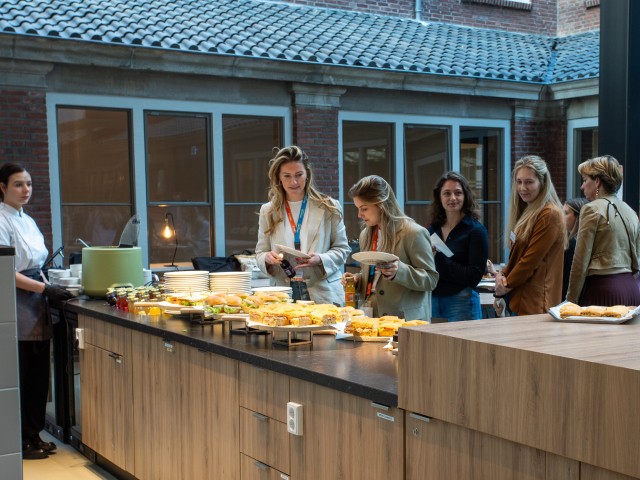
Our current focus is on establishing baselines for both topics. For inflow, Haskoning conducted a carbon emissions analysis across all procurement categories in 2023. We discovered that food and beverages alone account for 65% of our procurement-related emissions. In 2026, we will focus on supplier engagement and set category-specific KPI’s covering carbon emissions, biodiversity impact, waste reduction and social benefits. For outflow, we are conducting a waste audit with students in 2026 to understand our current generation volumes, separation rates, and contamination levels across campus. We also aim to increase our community’s waste separation awareness. We do not yet have all the data we need, and we are building our measurement systems as we go.
For procurement of goods and services, we aim to be a frontrunner. For building materials and waste management, we aim to be a good example. Both are serious commitments, and both require structural change across procurement, facilities, catering, and campus behaviour.
The challenges here are practical and ongoing. We will be documenting the decisions, the trade-offs, and what we are still figuring out.