
- About BUas
- Data Science & AI
- Research
Can talking to AI help students think more deeply?
What happens when an AI chatbot stops giving answers and starts asking questions? A new study at Breda University of Applied Sciences (BUas) explores how students develop, question, and reflect on their ideas through conversations with AI. What began as an experiment within the BUas AI Pioneering Programme in early 2025 has now resulted in an academic publication.
The study, Tracing Student Thinking in Socratic LLM Dialogues: A Reflexive Thematic Analysis, was conducted by researchers Qiqi Zhou and Carlos Pereira Santos from the Academy for AI, Games & Media, together with Tianyu Chen, a student in the BUas Master Imagineering programme. Combining educational research, software development, and data visualisation, they studied how students engage with AI-supported dialogue and how their thinking can be interpreted through qualitative analysis.
AI that asks questions instead of giving answers
While many AI tools provide quick answers, the researchers explored a different approach: can AI encourage students to think for themselves through Socratic questioning?
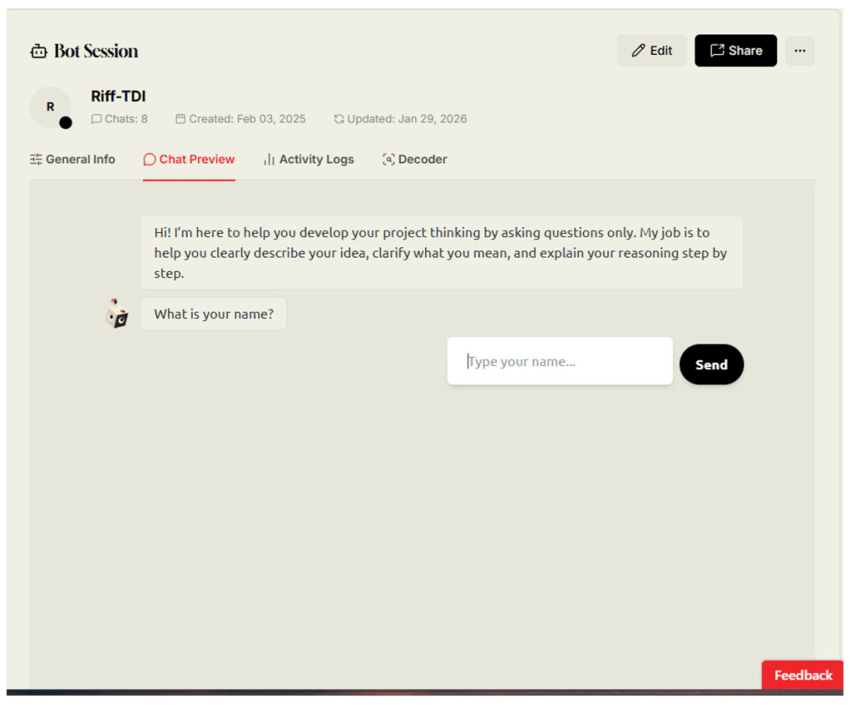
Students from seven project-based Creative Business courses were invited to use Riffbot.ai, an AI chatbot designed to help users clarify ideas, challenge assumptions, and consider alternative perspectives. Of the 115 students enrolled, 93 used the chatbot, generating 121 conversations. The researchers analysed 72 longer dialogues in detail.
What did the researchers discover?
The findings reveal a varied picture. Some students used the chatbot to refine ideas, deepen explanations, and reflect on assumptions. Others preferred direct answers or became stuck in repetitive exchanges. Simply asking more questions did not automatically lead to deeper thinking. Meaningful dialogue depended on how well the AI's questions connected with students' ideas and guided the conversation.
The researchers also found that students' reasoning did not follow a predictable path. Conversations often shifted between surface-level explanations and deeper reflection.
The study does not show that AI improves learning outcomes. Instead, it provides insights into how students engage with AI-supported questioning and identifies opportunities for reflection.
Making student thinking visible
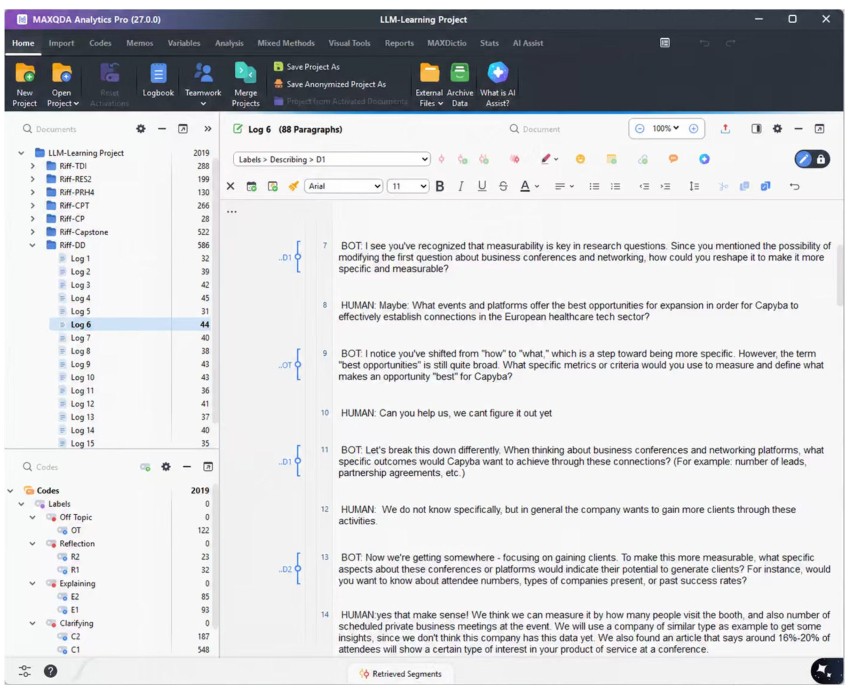
The project also explored an innovative way of studying student-AI conversations. By combining qualitative research with digital data tools, the team developed visual representations of dialogue patterns, helping them explore how different types of student responses appeared throughout conversations.
This approach opens new possibilities for research into data visualisation, visual storytelling, and the use of digital tools to better understand complex human interactions.
An educational institution that experiments
The publication shows how educational experiments at BUas can evolve into research with broader relevance.
At BUas, we encourage students and staff to experiment with AI while critically examining its role in education. This study is one example: colleagues tested a new tool in real courses, carefully analysed the results, and openly shared both the findings and the limitations.